Rules of the Game: Civic Engagement Under Threat – Legislative Updates
Issues
Executive Power & Civil Liberties
Topics
Community Organizing, Influencing Legislation, Public Charity Advocacy
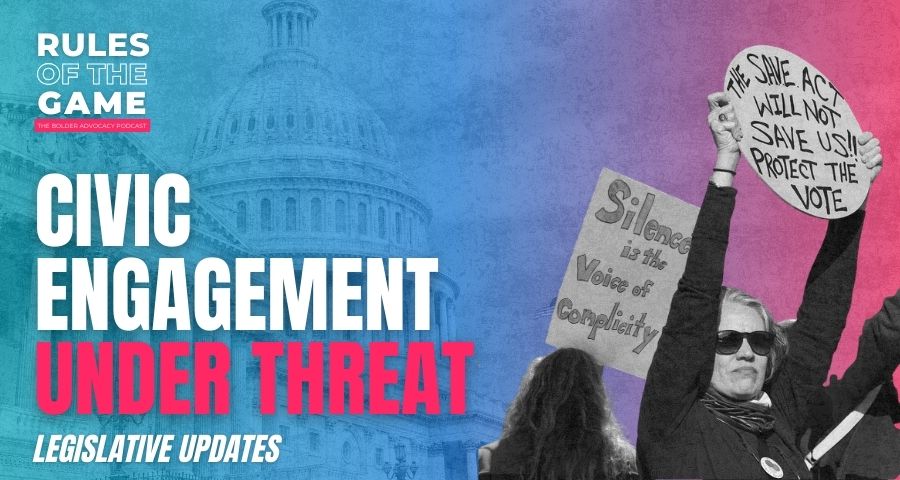
Legislative season is underway, and we’re seeing a wave of proposals that could significantly reshape the operating environment for nonprofits and advocacy organizations. We’re tracking over 1,000 bills across the country, and while some of them do positive things, like make improvements to our electoral system or increase voter turnout, unfortunately, most of these measures are taking aim at impactful nonprofit advocacy. These proposals collectively reflect an erosion of the civic space in the nonprofit ecosystem. We’re here to break down some of the key trends and help you stay informed about emerging twists in compliance.
Our Attorneys This Episode
- Maggie Ellinger-Locke
- Susan Finkle Sourlis
- Natalie Roetzel Ossenfort
Episode Overview
Federal Legislation
- The SAVE Act would require voter registration applicants to provide documentary proof of US citizenship and impose strict photo ID rules to vote in federal elections.
- Federal law is already clear that only US citizens are permitted to vote in federal elections.
- This legislation could disproportionately impact voters of color, married people who have changed their last names, and low-income voters.
State Legislation
- So far, we’ve seen over 150 bills filed in at least half the states, that seek to impact the voting process.
- Georgia’s SB 586 proposes sweeping changes to state elections including early voting. Under current law voters are permitted to cast their ballot at any polling location in their county during the early voting period. But if this bill becomes law, voters would be restricted to just one polling location.
- In West Virginia, SB 90 would prohibit voters not affiliated with a major political party from voting in a primary election.
- In Kansas, HB 2438 would prohibit online voter registration unless a website uses a .gov domain or is explicitly approved by the secretary of state.
- Corporate Power Reset movement: The goal of this movement is to create an end run around supreme court precedent like Citizens United and Buckley v Valeo by prohibiting all corporate, whether for profit or nonprofit, engagement with elections.
- Restricting foreign influence on ballot measure campaigns: Federal law already bans foreign national contributions to candidate campaigns, but these bills are seeking to extend the restrictions further, narrowing the funding landscape for direct democracy.
-
- During the 2026 state legislative sessions, we’ve seen 39 bills introduced in twenty states that would restrict foreign contributions to ballot measure campaigns.
-
- Some focus narrowly on majority foreign-owned businesses, but many target individuals and ballot question committees. These bills often require affirmative certifications that no foreign national funding is involved in an organization’s ballot measure advocacy.
- Baby FARA bills: At the federal level, the Foreign Agents Registration Act was enacted in 1938 to counter Nazi propaganda. It requires individuals or entities acting “at the order, request, or under the direction or control” of a foreign principal to register with the Department of Justice and file detailed disclosures.
-
- Historically, FARA has been applied in relatively specific circumstances, primarily lobbying or political work directly tied to foreign governments.
-
- State-level analogues, however, are often drafted much more broadly. These proposals could sweep in a wide range of advocacy activities and impact organizations engaged in international solidarity movements.
- Terrorism: US law only allows foreign groups to be labeled as foreign terrorist organizations. And new policy directs federal law enforcement agencies to “investigate and disrupt networks, entities, and organizations” that have views in contravention to the president’s.
-
- This type of legislation is now making its way to the states. In Florida, lawmakers are pushing several bills, such as HB 1471, SB 1632, and SB 1634, would dramatically expand the state’s power to designate organizations as “domestic terrorist organizations.”
-
- The bills broaden the definition of domestic terrorism, using sweeping language about activities intended to “influence the policy of a government” or “affect the conduct of government,” terms that could be interpreted expansively.
-
- Once designated, an organization could have its funds frozen, be barred from receiving state contracts or funding, and expose its staff, donors, and supporters to criminal liability for providing “material support.”
Hopeful Legislation
- In Georgia, lawmakers are considering a bill that would expand student protest rights, excusing absences for classes missed due to protest attendance.
- In Missouri, HB 1871 extends the “no excuse” absentee voting period from two weeks to four.
Resources
- Public Charities Can Lobby (Factsheet)
- Being a Player: A Guide to IRS Lobbying Regulations for Advocacy Charities
- Practical Guidance: What Nonprofits Need to Know about Lobbying in Your State