Rules of the Game: Election Coalitions
Topics
Community Organizing, Election Related Activities, Influencing Legislation
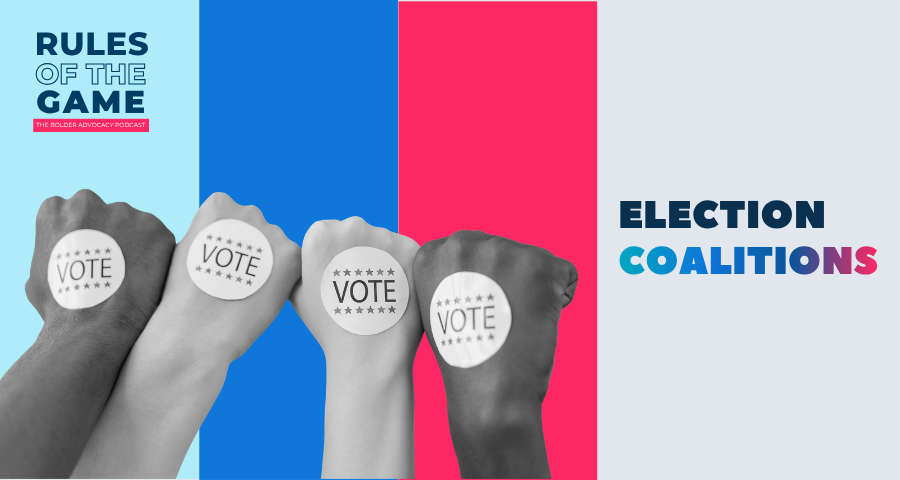
It’s mid-September and we are in the thick of election season. Ballots are going out, early voting is around the corner and many of you are working in coalitions on nonpartisan voter engagement. On this episode, we talk about what election coalitions are, why they’re important, and best practices for (c)(3)s and (c)(4)s that are in them.
Our Attorneys for This Episode
- Susan Finkle-Sourlis
- Quyen Tu
- Tim Mooney
About this Episode
Coalition Overview
- Definition of Coalition: Fully separate organizations with common goals, coming together for a set purpose
- Formal and informal coalitions
- Examples of coalition work
Four Principles for (c)(3)s
- Uphill and downhill- your organization can only fund what it can do
- Tax status stays with the organization, even when it’s a part of a coalition
- Proper documentation is essential
- Be sure you know what hat you’re wearing
Considerations for c4s
- Only engage in nonpartisan issue advocacy, ballot initiative campaigns, and nonpartisan voting rights campaigns when in coalition with (c)(3)s
- (c)(4)s have unlimited lobbying and may engage in some partisan activity
- A c4s tax status requires a primary purpose – can be achieved by lobbying ballot initiative and nonpartisan voter outreach
- Now the c4 can engage in partisan work outside these coaltion
Online Activity
- Must follow the same rules for (c)(3)s and (c)(4)s when engaging online
- Do your due diligence and know where links, tags, and hashtags go to
Resources
- The Connection: Guide to Creating and Operating 501(c)(3)s, 501(c)(4)s, and Political Organizations
- Comparison of 501(c)(3) and 501(c)(4) Permissible Activities (Factsheet)
- Navigating the Gray: Tips for working in coalition when the law isn’t clear (Factsheet)
- Coalition Checklist (Guide)
- 501(c)(3) and 501(c)(4) Collaboration (Factsheet)