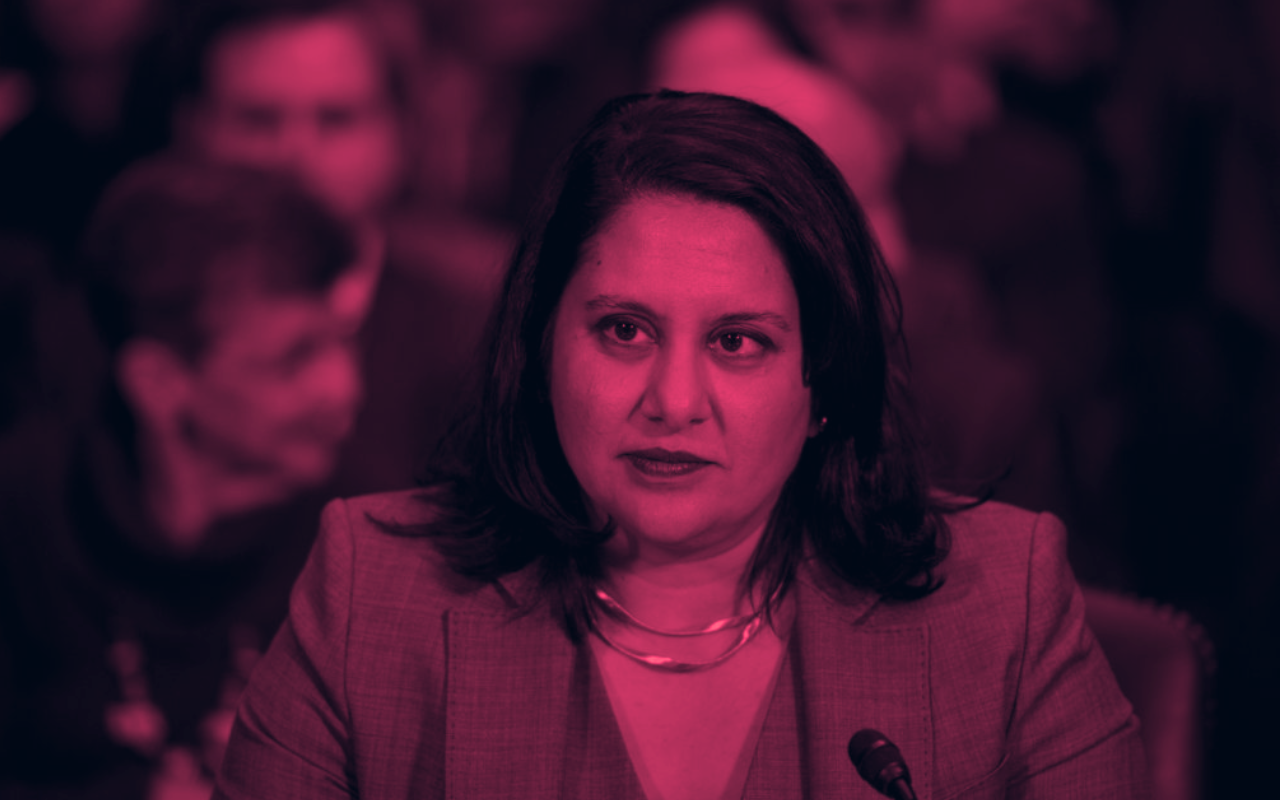
Neomi Rao has displayed hostility toward sexual assault survivors, LGBTQ+ rights, and environmental protections, while favoring unchecked executive power.
View/download the report here.
She has served as a judge on the U.S. Court of Appeals for the D.C. Circuit since her confirmation under the first Trump administration on March 8, 2019. She filled the seat left open by Justice Brett Kavanaugh after he was appointed to the Supreme Court.
Biography
Born in 1973 to immigrant physician parents from India, Rao grew up in Bloomfield Hills, Michigan and attended Yale University as an undergraduate, earning a B.A. in 1995. She then spent a year working as a reporter for The Weekly Standard, a neoconservative political magazine. She attended the University of Chicago Law School from 1996 to 1999 and received her J.D. in 1999.
Legal Experience
During law school, Rao clerked at the Institute for Justice in Arlington, VA and served as a summer associate with Gibson, Dunn & Crutcher LLP and Williams & Connolly LLP. Upon law school graduation, Rao clerked for Judge J. Harvie Wilkinson, III on the U.S. Court of Appeals for the Fourth Circuit from 1999 to 2000. From 2001-2001, Rao served as counsel for nominations and constitutional law to the U.S. Senate Committee on the Judiciary. She then clerked for Justice Clarence Thomas on the Supreme Court for the 2001–2002 term.
After her clerkship, Rao entered private practice at the London office of Clifford Chance LLP from 2002 to 2005. Her practice there included commercial law and public international law arbitrations. Rao left private practice to serve as the associate counsel and special assistant to the president from 2005 to 2006 during the second Bush administration. Following her time at the White House, Rao became a professor of law at George Mason University’s Antonin Scalia Law School. While at GMU, Rao founded the Center for the Study of the Administrative State, an organization committed to considering the constitutional and legal foundations of the administrative state.
Extreme Views
She has also expressed extreme views on executive power and the necessity of deregulation. During her Senate Judiciary hearing for the circuit seat, several senators expressed concerns about her college writings in the Yale Herald, where she noted, “[it]” has always seemed self-evident to me that even if I drank a lot, I would still be responsible for my actions” and “[a] man who rapes a drunk girl should be prosecuted. At the same time, a good way to avoid a potential date rape is to stay reasonably sober.”
She also wrote concerning statements in November 1993 for the Yale Free Press, including that “myths of racial and sexual oppression propagate themselves, create hysteria, and finally lead to the formation of some whining new group.”
In a 2008 law review article, Rao wrote criticized Lawrence v. Texas, 539 U.S. 558 (2003), which invalidated laws criminalizing same-sex relations. Rao also criticized the Supreme Court’s decision in United States v. Windsor, 570 U.S. 744 (2013), writing that the “[Supreme] Court’s use of dignity identifies a novel constitutional right to recognition unconnected to any substantive right.”
As administrator of the Office of Information and Regulatory Affairs (OIRA) under Trump, Rao sought to reverse regulatory protections for LGBTQ+ individuals in schools, the military, and health care. When Trump announced Rao’s nomination for the D.C. Circuit Court, 77 South Asian women civil and human rights lawyers, law professors, and survivor advocates signed a letter opposing Rao’s nomination. The letter highlighted that Rao’s OIRA policy decisions “led to the rollbacks of public protections relied upon by vulnerable communities, including women, survivors of sexual violence, and LGBTQ people.”
Her beliefs in originalism, textualism, and a strong unitary executive have largely aligned with Justice Thomas’s beliefs and writing. Here are some opinions she’s drafted while serving on the U.S. Court of Appeals for the D.C. Circuit:
Trump v. Mazars USA, LLP – Executive Power
Rao dissented from the D.C. Circuit Court of Appeals and sided with Trump, writing that the impeachment process is the only time Congress may investigate allegations of illegal conduct against the president. President Trump had challenged congressional subpoenas related to his businesses and entities. The district court and court of appeals both sided with Congress and agreed that the subpoenas were issued pursuant to legitimate legislative investigations.
Natural Resources Defense Council v. Wheeler – Environment
Rao dissented from the D.C Circuit Court of Appeals and argued that a 2015 EPA rule forbidding the use of hydrofluorocarbons (“HFCs”) as a substitute for ozone-depleting substances (since HFCs also led to climate change) was interpretive rather than legislative. As such, this rule was not subject to traditional notice-and-comment requirements and therefore did not create any new legal obligations for companies who wanted to switch to HFCs from other ozon-depleting substances.
National Treasure Employees Union, et. Al. v. Vought – CFPB reductions in force
Rao sided with the Trump administration and against Consumer Financial Protection Bureau (CFPB) employees, dissenting from an order that prohibited the Trump CFPB’s planned reduction in force during ongoing litigation. The D.C. Circuit had granted employees a partial stay (pause) on the Trump CFPB’s attempted dismantling of the congressionally established consumer protection agency. Rao characterized this order as “hamstring[ing] the Executive and prevent[ing] the CFPB from downsizing until the merits of the appeal are resolved.” She would have allowed the Trump CFPB to continue its layoffs.
Associated Press v. Budowich – First Amendment
In February 2025, Trump issued an order purporting to rename the Gulf of Mexico the Gulf of America. The Associated Press did not follow suit and was soon cut off from certain media events with the president. AP filed a suit against the White House chief of staff, her communications deputy, and press secretary seeking a preliminary injunction from being excluded due to its differing viewpoint. Trump-appointed D.C. District Court Judge Trevor McFadden granted the AP’s request, citing such a wholesale exclusion was “contrary to the First Amendment.” The U.S. Court of Appeals for the D.C. Circuit also granted this motion to stay, except to press events hosted in the East Room.
Writing for the majority, Rao also wrote that the AP was not likely to succeed on its viewpoint discrimination and retaliation claims, in part because the majority concluded that the Oval Office, Air Force One, and similar restricted spaces are not forums under the First Amendment. Furthermore, only 1% of journalists are able to access White House events in tight spaces and the First Amendment does not necessarily apply to the president’s communications at restricted press pool events.
Make the Road New York v. Wolf – Immigration
In 2019, the secretary of homeland security expanded the reach of the expedited removal process to sweep in all individuals without documentation who had resided in the United States for less than two years. Three organizations filed suit, contending that this decision violated the Administrative Procedure Act (APA), the Immigration and Nationality Act (INA), the Due Process Clause of the Fifth Amendment, and the Suspension Clause. The district court granted a preliminary injunction based only on the APA claims. On appeal, the Court of Appeals for the D.C. Circuit held that while the district court properly exercised jurisdiction over the case. The majority held that the Illegal Immigration Reform and Immigrant Responsibility Act text and statutory structure preserved the district court’s jurisdiction over the APA challenges but went on to hold that the organizations’ APA claims, based on notice-and-comment and reasoned decision making, could not stand. Judge Rao dissented, reasoning that the majority should have gone a step further and dismissed the organizations’ claims entirely. Rao argued that the INA expressly barred courts from reviewing the secretary’s discretionary decisions regarding expedited removal and she critiqued the majority opinion as “another marker on the road to government by injunction.”
Circus Circus Casinos, Inc. v. National Labor Relations Board – Labor
This case involved a petition for review of an order of the National Labor Relations Board (NLRB) determining that an employer (a casino) committed unfair labor practices by investigating an employee without a union representative present, terminating the employee based on their union membership, and threatening the employee for exercising statutory rights under the National Labor Relations Act (NLRA). Writing for the majority, Rao held, among other things, that the employee did not sufficiently communicate his desire for representation at an investigation meeting. The employee was given the contact information for the union to arrange for representation at the meeting. Once he arrived, the employee stated that he had called the union three times, no one had shown up, and he was there unrepresented. According to Rao’s majority opinion, this was insufficient to trigger the employee’s entitlement to representation. The majority expressed concern that if the employee’s comments were considered “requests” for representation under the NLRA, cautious employers would have to assume that the right to union representation automatically applied to all covered investigatory meetings.