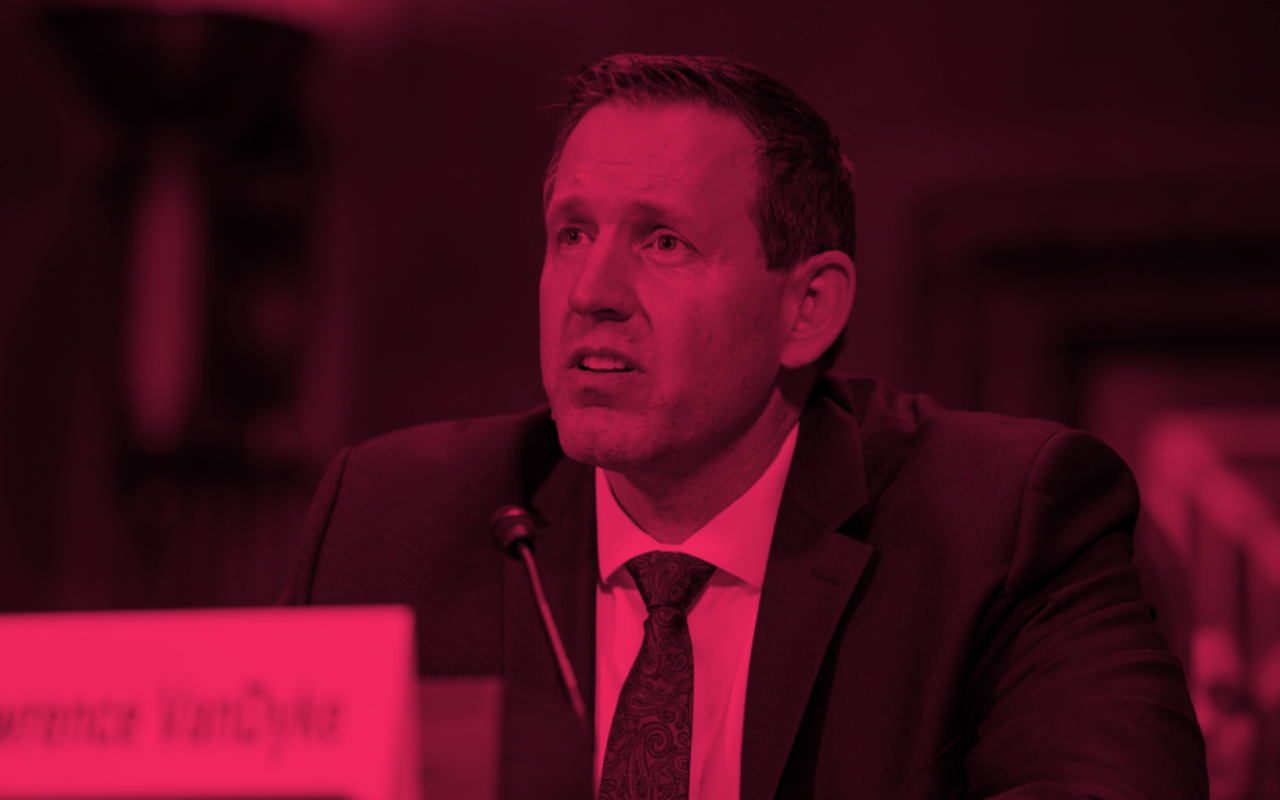
Lawrence VanDyke was rated not qualified by the American Bar Association noting, “…Mr. VanDyke is arrogant, lazy, an ideologue, and lacking in knowledge of the day-to-day practice including procedural rules.” He has shown his dedication to serving partisan interests at the expense of clean air, clean water, reproductive rights, LGBTQ equality, criminal justice, and education.
He has served as a judge on the U.S. Court of Appeals for the Ninth Circuit since January 2020.
View/download the report here.
Biography
He was born in Midland, Texas on December 12, 1972, and attended Oklahoma Christian University from 1992 to 1995 without receiving a degree. He attended Montana State University from 1995 to 1997 and graduated with a B.S. in English. He also received a M.C.E.M. from Montana State University in 2000, and a B.Th. from Bear Valley Bible Institute in 2002, and a J.D. from Harvard Law School in 2005. In the summer of 2003, VanDyke interned at the Alliance Defense Fund (ADF), now the Alliance Defending Freedom, which the Southern Poverty Law Center has designated as an anti-LGBTQ+ hate group. He has been a member of the Federalist Society since law school.
Legal Experience
Upon graduating from law school, VanDyke worked as an associate attorney at Gibson Dunn & Crutcher in the Washington, D.C. office from 2005 to 2006. From 2006 to 2007, he clerked for Judge Janice Rogers Brown of the U.S. Court of Appeals for the D.C. Circuit. He returned to Gibson Dunn after his clerkship and worked as an associate in their Dallas, Texas office from 2007 to 2012. During this time, VanDyke did pro bono work for ADF and the Free Market Foundation.
VanDyke served as the assistant solicitor general for Texas in 2012, then served as the Montana solicitor general from 2013 to 2014. From 2015 to 2019, he served as the Nevada solicitor general, where he helped establish a Federalism Unit to fight so-called “illegal overreach” by the federal government on issues related to immigration, the environment, and health care. During this time, VanDyke’s efforts stopped the enforcement of the EPA’s 2015 “Waters of the United States” rule, which provided that rivers, streams, wetlands, and other waterways are protected under federal law in order to make sure upstream pollution doesn’t harm downstream communities. VanDyke became the deputy assistant attorney general for the U.S. Department of Justice’s Environment and Natural Resources Division, where he served from 2019 until his confirmation as a Ninth Circuit judge.
ABA Rates VanDyke “Not Qualified”
In October 2019, ahead of VanDyke’s Senate Judiciary hearing on his Ninth Circuit nomination, the American Bar Association (ABA) released a letter that opposed his nomination. After 60 interviews, the ABA rated VanDyke “not qualified” for the position. They noted, “Mr. VanDyke’s accomplishments are offset by the assessments of interviewees that Mr. VanDyke is arrogant, lazy, an ideologue, and lacking in knowledge of the day-to-day practice including procedural rules.” The letter also noted: “There was a theme that the nominee lacks humility, has an ‘entitlement’ temperament, does not have an open mind, and does not always have a commitment to being candid and truthful.” The letter continued: “Even though Mr. VanDyke is clearly smart, comments were made that in some oral arguments he missed issues fundamental to the analysis of the case. There were reports that his preparation and performance were lacking in some cases in which he did not have a particular personal or political interest.” The ABA also alleged that VanDyke would unfairly judge LGBTQ+ litigants.
Ninth Circuit Extremism
As previously feared, VanDyke’s tenure on the Ninth Circuit exemplifies ideologically driven decisions that prioritize extreme policy shifts over established precedent. He’s also used harmful and inappropriate language in his decisions, which has sparked a backlash even among his judicial colleagues.
Judicial Temperance and LGBTQ+ Rights
In Olympus Spa v. Armstrong, VanDyke sparked backlash when he used vulgar language to attack the Ninth Circuit’s refusal to rehear a decision upholding Washington’s public accommodations law. The law bars businesses from excluding transgender women, and the plaintiff spa owners in this case tried to ban transgender women from their facilities. In his dissent, VanDyke agreed and called the controversy “a case about swinging dicks.”
He wrote: “You may think that swinging dicks shouldn’t appear in a judicial opinion…You’re not wrong. But as much as you might understandably be shocked and displeased to merely encounter that phrase in this opinion, I hope we all can agree that it is far more jarring for the unsuspecting and exposed women at Olympus Spa — some as young as thirteen — to be visually assaulted by the real thing.” He further wrote that it “feels like the supposed adults in the room have collectively lost their minds” and dubbed his colleagues’ decision as “woke judges’ willingness” to sacrifice constitutional rights “on the altar of ‘social progress.’”
In response to this inappropriate and offensive language, Judge McKeown, who authored the majority opinion in the case, also authored a separate statement joined by 26 fellow judges, including the Chief Judge. This statement noted that “[t]he American legal system has long been regarded as a place to resolve disputes in a dignified and civil manner or, as Justice O’Connor put it, to ‘disagree without being disagreeable.’ It is not a place for vulgar barroom talk.” Van Dyke’s language “makes us sound like juveniles, not judges” and “undermines public trust in the courts.” Two additional judges filed a separate statement that simply states: “Regarding the dissenting opinion of Judge VanDyke: We are better than this.”
In addition to using provocative language, Judge Van Dyke’s dissent made assertions that had no support in the record, such as noting that Washington’s law “will be used by sexual deviants to prey on women in female-only spaces.”
Access to Reproductive Care
In United States v. Idaho, VanDyke authored an order granting the Idaho Legislature’s request to stay a district court injunction blocking enforcement of Idaho Code § 18‑622, a statute that prohibits physicians from performing abortions unless, among a few narrow exceptions, “the physician determine[s], in his good faith medical judgment and based on the facts known to the physician at the time, that the abortion was necessary to prevent the death of the pregnant woman.”
The federal government argued that the Idaho law is preempted by the Emergency Medical Treatment and Labor Act (EMTALA), which requires hospitals to provide stabilizing emergency medical care regardless of a patient’s ability to pay, which has become a major point of conflict in the post‑Dobbs environment. Although EMTALA theoretically preempts directly conflicting state laws, clinicians nonetheless face acute uncertainty. When a complication clearly threatens the patient’s life, doctors may feel confident that an emergency abortion fits within state‑law exceptions. Some conditions evolve unpredictably, and the risk of license revocation or criminal penalties may push physicians to delay necessary interventions until the threat is unmistakably grave — often too late to prevent catastrophic harm. The result, VanDyke’s critics warn, is that patients’ lives and health may be jeopardized by medical hesitation driven by legal ambiguity rather than clinical judgment.
Dissent to California’s Ban on Magazines
In Duncan v. Bonta, the Ninth Circuit upheld California’s ban on magazines holding more than 10 rounds. In response, VanDyke released an 18-minute video dissent that accused the court of systematically undermining the Second Amendment. The video features VanDyke loading and unloading his own handguns in his chambers. He argued that “the majority of our court distrusts gun owners and thinks the Second Amendment is a vestigial organ of their living constitution,” criticizing the court’s “laughably ‘heightened’ Second Amendment scrutiny.” He characterized his colleagues’ approach to Second Amendment interpretation as akin to rational‑basis review, which ensures that “no government regulation ever fails” under the circuit’s test.
Immigration
In East Bay Sanctuary Covenant v. Biden, several nonprofit legal services organizations challenged a 2018 regulation (interim final rule) that rendered migrants ineligible for asylum if they crossed the southern border between ports of entry. The Ninth Circuit affirmed a temporary restraining order and a subsequent preliminary injunction blocking the rule, holding that it “irreconcilably conflicts with the INA and the expressed intent of Congress.” The panel concluded that the Immigration and Nationality Act expressly allows migrants to apply for asylum “whether or not at a designated port of arrival,” and that the rule was therefore “effectively a categorical ban” on a method of entry Congress permitted.
VanDyke dissented from the denial of rehearing en banc. He argued that the court improperly expanded organizational standing “beyond Article III’s reach,” contending that the majority’s theory allowed organizations to sue whenever a policy produces even “one less client,” which he warned “will lead to significant unintended consequences.”
LGBTQ+ Rights
In Green v. Miss United States of America, Anita Green, a trans woman, sued the pageant under the Oregon Public Accommodations Act (OPAA) after being denied entry based on its “natural born female” rule. The pageant argued that applying the OPAA would violate its First Amendment rights. Writing for the panel, Judge VanDyke affirmed summary judgment for the pageant, holding that beauty pageants are expressive productions and that forcing the pageant to include Green would unconstitutionally compel speech.
VanDyke contended that the pageant expresses a message about “the celebration of biological women,” and that its ability to choose contestants is inseparable from that message. He further claimed that “there is no daylight between speech and speaker” in a pageant, where “who competes…is how the pageant speaks.” Requiring inclusion of a contestant who does not meet its definition of womanhood would “fundamentally alter the Pageant’s expressive message,” he wrote.
Gun Rights
In McDougall v. County of Ventura, VanDyke sat on a three‑judge panel that reviewed a district court decision upholding Ventura County’s COVID‑19 restrictions. When the pandemic began in March 2020, the county issued stay‑at‑home orders instructing residents not to leave their homes except for essential work or to obtain essential goods. Two residents and several gun‑rights organizations filed suit against Ventura County, arguing that the restrictions violated their Second Amendment rights by preventing them from purchasing firearms and ammunition that could not be bought online lawfully.
A federal district court dismissed the case, citing the Supreme Court’s 1905 ruling in Jacobson v. Massachusetts, which affirmed broad governmental authority to curb epidemics, as well as the Ninth Circuit’s existing Second Amendment jurisprudence. In his opinion, VanDyke wrote that “the acute need for Second Amendment rights during temporary crises was well‑understood by our Founders,” asserting that emergencies heighten, rather than diminish, the importance of constitutional protections.