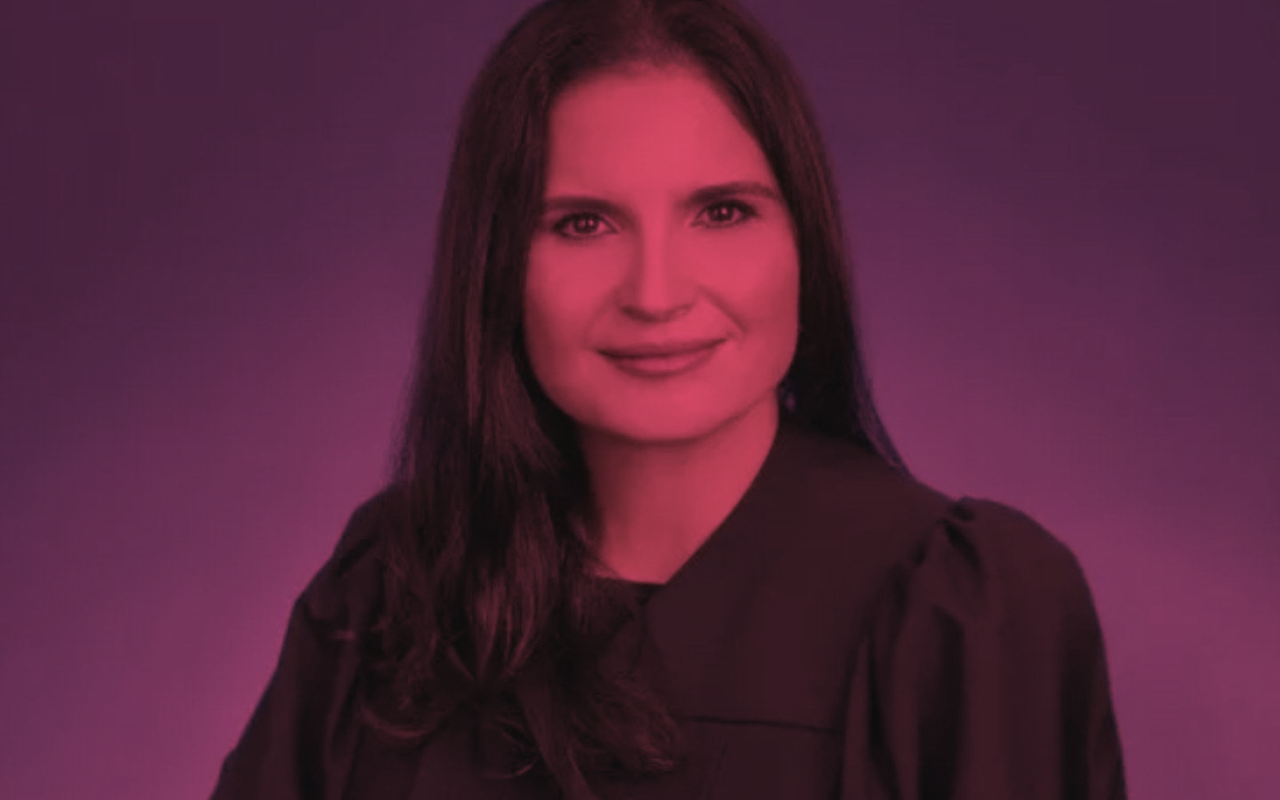
Judge Aileen Cannon has placed herself at the center of dangerous attacks on the rule of law. Ignoring decades of legal precedent, she embraces fringe arguments that even most conservative judges have rejected.
View/download the report here.
Biography
Aileen Cannon was born in Cali, Colombia in 1981. She received a B.A. from Duke University in 2003 and a J.D. from the University of Michigan Law School in 2007. After finishing law school, she clerked for Judge Steven Colloton of the U.S. Court of Appeals for the Eighth Circuit. In 2009, she joined Gibson & Dunn’s Washington, D.C. office as an associate. She spent three years at Gibson & Dunn before transitioning to the Assistant U.S. Attorney’s Office for the Southern District of Florida in 2013. While at the U.S. Attorney’s Office, Cannon worked in the Major Crimes Division and the Appellate Division. On November 13, 2020, President Trump appointed her to U.S. District Court for the Southern District of Florida.
Infamously Presided Over Two Trump Cases
Since becoming a federal judge, Cannon is best known for her handling of two cases — one criminal and one civil — involving Trump. The first case was Trump v. United States, which involved the FBI’s search of Trump’s Mar-a-Lago residence. Trump requested that the court appoint a special master to review materials seized during the search for attorney-client and executive privilege. Cannon promptly granted the request and halted the FBI’s access to the classified documents seized during the search. The Department of Justice immediately appealed and requested that the Eleventh Circuit stay Cannon’s orders.
An Eleventh Circuit panel unanimously granted the DOJ’s request, stating that Cannon abused her discretion by preventing the government from using approximately 100 lawfully seized documents that Trump claimed were classified. The panel also held that Cannon erred in exercising equitable jurisdiction over the case, as such jurisdiction should only be exercised in exceptional circumstances. The panel was unwilling to “drastically expand the availability of equitable jurisdiction . . . or carve out an unprecedented exception in our law for former presidents.”
The DOJ also appealed Cannon’s decision to appoint a special master. Once again, an Eleventh Circuit panel unanimously overturned Cannon’s order, stating that her decision “would be a radical reordering of our caselaw limiting the federal courts’ involvement in criminal investigations,” which “would violate bedrock separation-of-powers limitations.” The panel remanded the case back to Cannon and ordered her to dismiss it for lack of jurisdiction.
Less than a year later, Cannon was assigned the DOJ’s criminal case against Trump related to his alleged mishandling of classified government documents. Given Cannon had been assigned the related civil case 10 months prior, several federal judges, including the chief judge of the Southern District of Florida, recommended that she recuse herself. However, Cannon refused to do so. Pretrial, Cannon made a series of rulings that were viewed as highly favorable to Trump, from denying the DOJ’s request to keep its potential witness list under seal to delaying a hearing on the Classified Information Proceedings Act for several months.
Cannon’s delay tactics continued when she postponed the trial “indefinitely” less than two weeks before it was set to begin. Ultimately, Cannon granted Trump’s motion to dismiss on July 15, 2024, reasoning that Special Counsel Jack Smith’s appointment violated the Appointments Clause of the Constitution. This reasoning was based largely on Justice Thomas’s fringe legal theory that special counsels are always unconstitutional. The government initially appealed Cannon’s decision but dismissed its appeal after Trump won the presidential election in November 2024. Smith then attempted to release his final report to the Congress and the public, but Cannon blocked him from doing so.
Additionally, despite her relatively short time on the federal bench, Cannon has developed a reputation for treating her clerks terribly. According to one of her former clerks, Cannon would “get angry to the point of screaming.” Cannon expected to control what her clerks did 24/7 and did not allow them to have personal lives. Cannon frequently required her clerks to come into the office on weekends and federal holidays, despite not coming in herself for the vast majority of those days. Cannon also consistently set impossible deadlines that required clerks to work overtime and rush their final product, which only contributing to more yelling and screaming. Her former clerk said 100+ hours of work a week was not uncommon.
Overall, Cannon’s unquestioning loyalty to Trump and her horrific treatment of her clerks show she is unqualified for her current judgeship, much less a promotion to the Supreme Court.