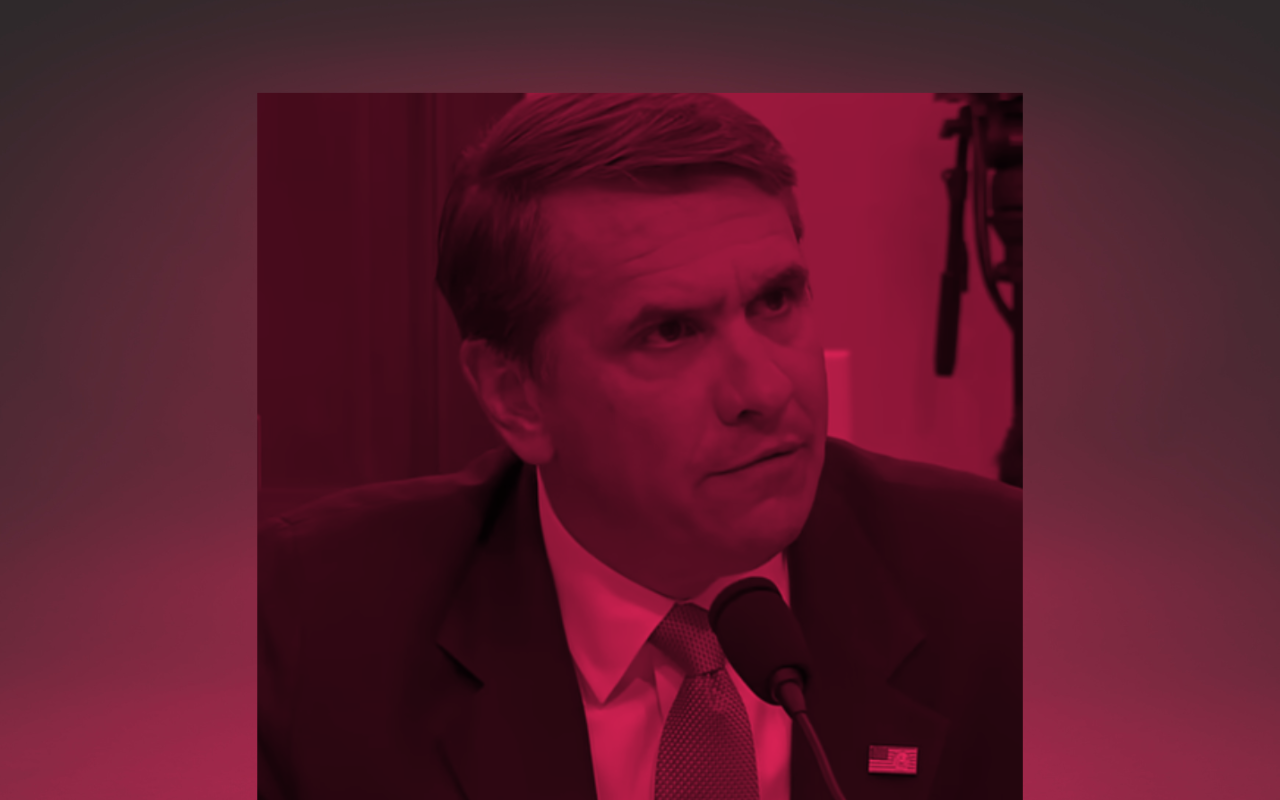
On April 2, 2026, Blanche became acting attorney general following the removal of the previous attorney general, Pamela Bondi. In June 2026, Trump officially nominated Todd Blanche to be the next attorney general and he was confirmed on August 8, 2026.
Blanche has spent his career politicizing government, standing in the way of justice for victims, and carrying out Trump’s bidding to harm those who stand in the way of his authoritarian agenda. Blanche is poised to use his power to do more harm to everyday people and the institutions they rely on.
View/download our report here.
View/download our letter of opposition here.
Background
Born in 1974 in Denver, Colorado, Todd Blanche earned a bachelor’s degree from Louisiana State University in 1994 and a J.D. from Brooklyn Law School in 2003. After law school, he clerked for Judge Denny Chin on the District Court for the Southern District of New York and Judge Joseph Bianco on the District Court for the Eastern District of New York. From 2006 to 2014, he worked in the violent crimes division of the U.S. Attorney’s Office for the Southern District of New York. Afterwards, he served as partner at law firms, first at WilmerHale and then Cadwalader, Wickersham & Taft. As a partner at Cadwalader, Blanche represented Paul Manafort and Boris Epshteyn, two close associates of President Trump.
Beginning in 2023, Blanche represented Trump in federal criminal cases concerning unlawful retention of classified government records and obstruction of the 2020 presidential election as well as a state criminal case involving falsification of business records. In 2024, the Florida district court dismissed the unlawful retention of records case on the grounds that the government’s appointment of Special Counsel Jack Smith violated the Appointments Clause. After Trump won the November 2024 election, the D.C. district court granted the Special Counsel’s motion to dismiss the obstruction of election case indictment under the Justice Department’s policy of not pursuing a criminal prosecution against a sitting president. Trump was found guilty in the falsification of business records case, but after the November 2024 election, the case ended with a sentence of an unconditional discharge, which is a final judgment of conviction that does not impose any penalty or condition.
From Deputy Attorney General to Attorney General
In November 2024, then-President-elect Trump nominated Blanche for deputy attorney general. During the Senate confirmation process, Blanche faced many questions regarding his personal ties to Trump and his views on the relationship between the Department of Justice and the White House. He provided little detail, while asserting that the Department had been weaponized under the Biden administration.
The Senate confirmed Todd Blanche as Deputy Attorney General in March 2025 by a 52–46 vote.
Cases and Controversies
Trump v. United States
As Trump’s defense counsel in Trump v. United States, Blanche co-authored a Supreme Court brief arguing that a former president is entitled to absolute immunity from criminal prosecution for all of his official acts unless he was impeached and convicted under the Impeachment Clause. The Supreme Court’s final opinion held that a former president is entitled to absolute immunity from criminal prosecution for actions within his conclusive and preclusive constitutional authority and to at least presumptive immunity from prosecution for all of his official acts.
Mishandling of Epstein files
While serving as deputy attorney general, Blanche oversaw the release of the Epstein files following the passage of the Epstein Files Transparency Act. While the act directed the Justice Department to release these files by December 19, 2025, the DOJ only partially released the files by December 2025, with some documents even including the unredacted names of victims. Blanche noted there would be no more major Epstein document releases after another tranche was released in January 2026.
Victims and critics have argued that the department has mishandled the release. In March 2026, a group of victims filed a class action lawsuit, alleging that the department failed to protect the victims’ privacy while releasing the files. Blanche subsequently admitted that the department committed errors in the release process, while adding that the improperly released information constituted only a small portion of the files. In April 2026, a journalist filed a lawsuit against Blanche, alleging that the department withheld or retracted key documents and failed to explain redactions as required by law. On April 23, 2026, the Department of Justice Office of Inspector General announced an audit of he department’s compliance with the act.
Possible violation of the federal conflicts of interest statute
In December 2025, ProPublica reported after he became the deputy attorney general but before he divested his cryptocurrency holdings, Blanche issued a memo ending ongoing investigations into cryptocurrency businesses and reduced the department’s enforcement efforts against crypto-related fraud and money-laundering schemes. ProPublica estimated that Blanche’s crypto holdings were at least $159,000 at the time he issued the memo and withdrew the department’s crypto enforcement efforts. Six Senate Democrats sent a letter to Blanche, raising concerns about a potential violation of federal conflicts-of-interest statute.
Views on presidential influence over Justice Department investigations: When serving as acting attorney general, Blanche responded to a question about prosecuting Trump’s political opponents that it was the president’s “right” and “duty” to influence investigations into people whom “the president in the past has had issues with and believes should be investigated.”More recently, when asked about concerns around the politicization of the Department of Justice, Blanche responded that high-profile cases against Trump’s political opponents are only a minor part of the department’s larger volume of work and said Article II of the Constitution clearly grants the president the right to lead the country “in all areas,” including criminal justice.
Retaliatory charges against Kilmar Abrego Garcia
Kilmar Abrego Garcia was living in the United States when he was wrongfully deported to El Salvador and then brought back to the United States under a court order in 2025. Before he was returned, the Department of Justice charged him with human smuggling. On May 22, 2026, the federal District Court for the Middle District of Tennessee dismissed the charges of human smuggling against Abrego Garcia, finding that the prosecution was vindictive retaliation against the defendant.
In dismissing the charges, the court found that there was significant proof that the investigation into Abrego Garcia was initiated in retaliatory response to a court ruling ordering his return. Among the proof cited by the court was Blanche’s interview on a cable news network, where he described the department’s investigation into Abrego Garcia as the following: “a judge in Maryland . . . questioned that decision [to deport Abrego Garcia] . . . [w]hen we started looking into it . . . [w]hat we found is that we were right. We were right. He is a criminal who should be deported.” The court proceeding also revealed internal Justice Department emails suggesting that Mr. Blanche’s office pressed for charges to be filed against Abrego Garcia.
IRS settlement and anti-weaponization fund
On May 18, 2026, the Department of Justice, on behalf of the United States, entered into a settlement of President Trump’s suit against the Internal Revenue Service surrounding an IRS contractor’s unauthorized release of his tax returns in 2018. As part of the settlement, the government agreed to create an “Anti-Weaponization Fund” with $1.78 billion in funds. The government also agreed to be forever barred from pursuing claims or reviews against Trump based on his and his family’s past tax returns. Both documents were signed by Blanche.
During his testimony before Congress, Blanche described the purpose of the Anti-Weaponization Fund as addressing the flaws in “the legal system [that] was not set up to compensate for what the Democrats and what Biden and what Garland did for four years.” He stated that he would appoint five commissioners to govern the fund, and that Trump would have the ability to remove the commissioners. As to the individuals eligible to pursue claims against the fund, Blanche stated that individuals who attacked the Capitol on January 6, 2021 and Trump’s political donors will not be excluded.
Remarks about politicizing the FBI
In March 2026, Blanche stated at the Conservative Political Action Conference that, after Director of the Federal Bureau of Investigation Kash Patel “cleaned house” at the agency, there “[wa]sn’t a single man or woman with a gun, federal agent, still in that organization that had anything to do with the prosecution of President Trump.” Following these remarks, former FBI agents filed a lawsuit, arguing that they were fired as part of a political retribution campaign.